|
|
|
When a small group of ACES (American Chevelle Enthusiasts Society) Members got together to admire each others Chevelles in a soggy hotel parking lot in Nashville, Tennessee 14 years ago, none of them ever thought they were launching what would become the largest Chevelle show in the world. Now they know.
From the beginning, Chevell-abration was intended to be a fun, family-oriented event and apparently, it’s a formula that works. ACES President, Chuck Hanson is glad it does. “After being involved with a number of clubs and shows over the years, and listening to others talk about what they liked and didn’t like, we had a pretty clear-cut direction that we wanted take things.”
Word spread quickly about the ACES organization and the annual Chevell-abration that was actually an annual convention for the Membership. Today, Membership in the organization is comprised of nearly 10,000 enthusiastic Chevelle owners!
As Chevell-abration evolved, however, it became much more than a car show. A swap meet provides plenty of hard-to-find NOS and used parts, while reproduction items can be purchased from a number of vendors filling the Midway. Several educational seminars are held daily, with interesting topics from hot rodding to restoration. Nearby Music City Raceway provides a place for owners of American’s Favorite Musclecar to burn rubber and feed the need for speed one night, while the next you can find many of the participants grinding the sidewalls off their tires as they thrash their way through the autocross.
There’s also plenty of activities for both young and old kids alike, with several competitive participant events designed to keep everyone active. You can try your luck at the creeper races, the pedal car drags, or even redneck horseshoes if the urge strikes you, or yell for your favorite to win in any of the games.
This year’s event will be held June 10-12, at Moss-Wright Park in Goodlettsville, TN. Just 15 minutes north of downtown Nashville, it’s a Chevelle-lover’s paradise. Participation on the show field is restricted to only ACES Members and their ’64-87 Chevelles, Malibus and El Caminos. Of course, it’s never too late to become an ACES Member, and you can join on line here: https://www.worldcomputing.com/aces/
For more information on Chevell-abration, call 615.643.ACES (2237) from 9-5pm CDT.
|
|
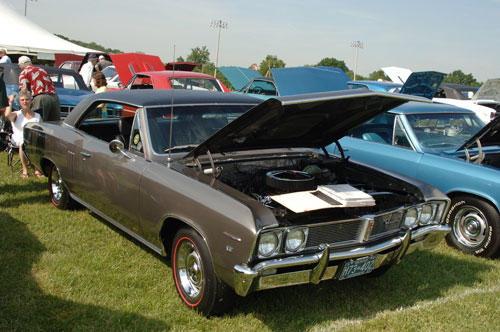
This rare Beaumont SD396 belongs to Rick Mitchell, who drove it down from Ontario, Canada.
He’s the original owner of this Canadian cousin to the Chevelle.
|
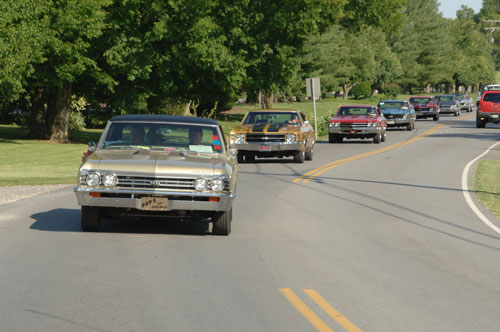
Cruises are part of the action, too, and there’s nothing cooler than to see a string of beautiful
Chevelles rumbling past. The aroma of combusted race fuel can be addictive!
|
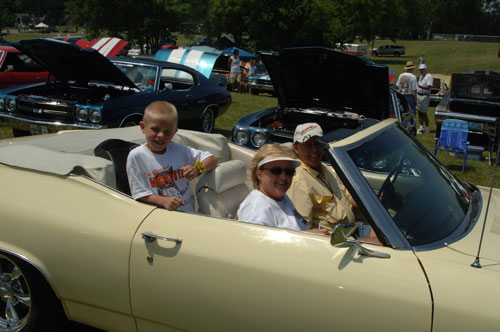
It’s a fun, family event, and that means both young and old kids
will have a great time at Chevell-abration.
|
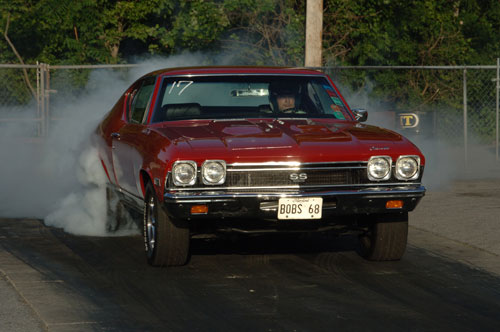
Chevelles are winners at the track, and on the street. Here, Maryland’s Bob Wilcox
lets the smoke out of his sticky street radials!
|
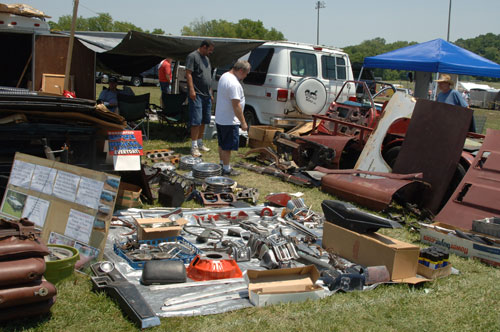
Nearly anything you need or want for your Chevelle can be found in the swap meet,
whether you’re looking for NOS parts or previously installed items.
|
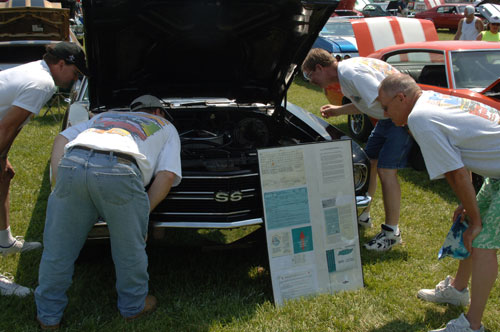
Want to see how they came off the assembly line? This low-mileage LS6 Survivor
attracted interested lookers all weekend.
|
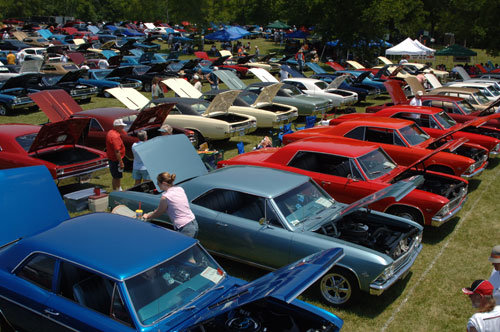
If you like ’66-7 Chevelles, they comprise some of the largest classes at the event.
Out of this endless sea of Chevelles, you’re guaranteed to find one that spins your crank!
|

Headin’ home, this young Chevelle enthusiast takes one last look at the show field, and smiles knowing that next year will be even bigger and better…
Happiness is a big-block, and a drop top!
|
 |
When it comes to high-performance engine swaps into muscle car-era cars, the GM Gen III/Gen IV engines commonly known as the “LS” family offer plenty of great advantages. With everything from iron-block, 4.8-liter truck engines to the 6.2-liter supercharged high-output versions pushing nearly 640 horsepower out of the box, these 21st century V-8s frankly outgun the engines of the muscle car era.
|
|
They’re also lighter – automotive and some truck engines feature an aluminum block, heads and a plastic intake manifold – and feature greater durability features, including cross-bolted, six-bolt main caps and a deep-skirt cylinder block design. LS cylinder heads flow tremendously well, too, and most racers from the 60s would have ruled the strip with a set of untouched, factory LS head castings.
Frankly, there’s less politically incorrect baggage when installing an LS engine in, say, a Pontiac or Olds, because as a corporate-developed engine that came long after the traditional period of brand-engineered engines, there’s not the same stigma of, say, dropping a small-block Chevy in Lemans or a big-block Chevy in a Buick. That was the thinking behind a project we’re following, in which a late-model LS2 engine is being dropped into a 1965 Pontiac Tempest wagon.
For the sake of simplicity and period aesthetics, it was decided to replace the factory fuel injection system for a simple four-barrel carb setup. Fortunately, the parts for this – as well as the engine swap itself – are readily available and getting more affordable every day. And to give a more appropriate look under the classic Pontiac’s hood, it would be dressed as nostalgically as possible, including painting it Pontiac blue and capping it with a GTO-style chrome air cleaner. The engine was also fitted with a new, higher-lift camshaft from Comp Cams. That puts the estimated output at 430 horsepower.
|
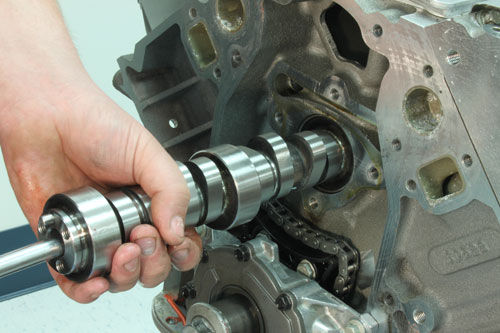
Before dressing the used LS2 engine, it was freshened with a new,
high-performance camshaft from Comp Cams.
|
|
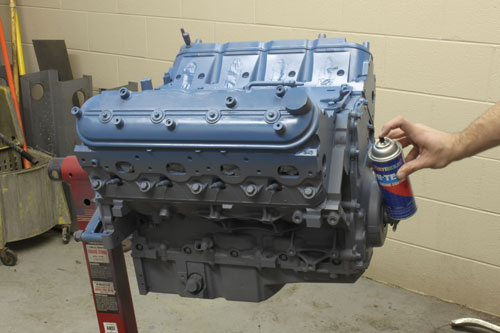
With the engine’s internals buttoned up, the engine was primed and sprayed with Pontiac blue
engine paint ordered from OPGI. Special care and prep work must be taken when
painting aluminum engine parts, which includes the block and heads on the LS2.
|
|
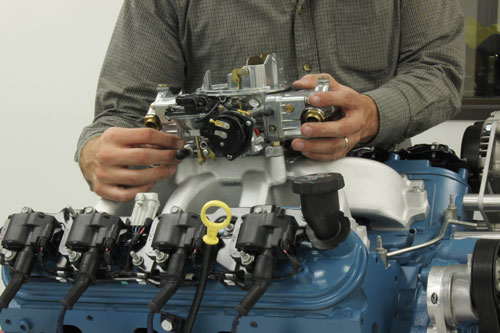
When the paint dried, the accessories and intake system were installed, including an
four-barrel intake and a 750-cfm carburetor. Note the coil packs on the valve covers, which
are a signature of distributorless LS engines. Custom valve covers and kits that move the
coils off the valve covers are available.
|

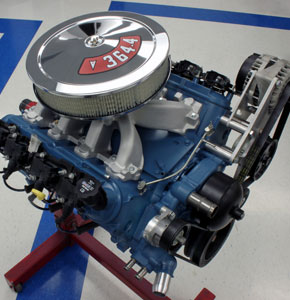
A finishing detail for the engine is a GTO-style chrome air cleaner dressed with a modified,
original-style decal. The “326-4” decal is available from OPGI and it was scanned to help create
a “364-4” decal that matches the displacement of the LS2. Clever, huh?
|
|
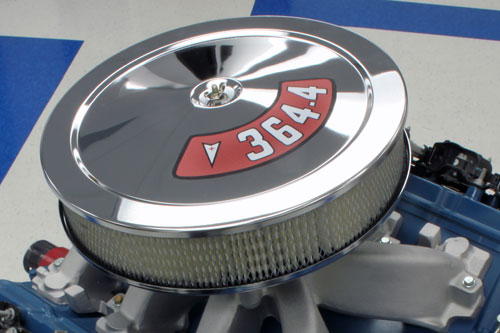
The new “364” decal was printed out on sticker paper, cut out and affixed to the air cleaner lid.
|
|
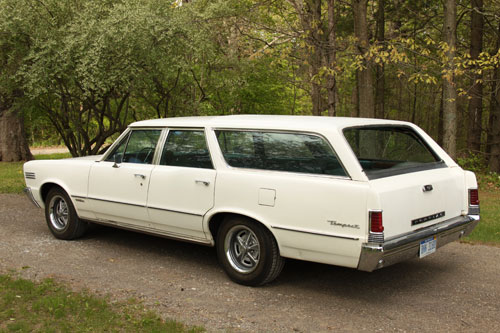
This ’65 Tempest wagon will be the new home for the restified LS2 engine, replacing a tired 326 engine. It will also be the recipient of a number of additional DIY interior and chassis resto projects that we hope to show you in upcoming newsletters.
|
|
For the dress up items that gave the engine its vintage look, they all came from Original Parts Group Inc.’s catalog, including a few cans of Pontiac blue engine paint, the chrome air cleaner and a restoration “326-4” air cleaner decal that was used to create a new, “resto-mod” decal. The OPGI-supplied resto sticker was scanned and the electronic file of it was modified with PhotoShop to rearrange the numbers on it to create a new designation: 364-4, which matches the cubic-inch displacement of the 6.0L LS2 engine. Then, the new decal was printed out on sticker paper, carefully cut out and placed on the air cleaner lid. The result is a factory-looking decal that will cause double-takes at car shows.
The same dress-up tricks used on this LS2 could easily be applied to engine destined for a resto-mod Olds, Buick, Chevy or Cadillac. And because LS engines have been used for well more than a decade now, the prices of used engines and new crate motors are getting cheaper every day. The LS2 is a good choice, because it accepts both the more commercially available aftermarket parts for early-style “cathedral”-port heads and the later, high-flow rectangular-port heads. You’ll also find plenty of affordable iron-block 5.3L engines from full-size trucks. They make great foundations for building up to about 500 horsepower, although you’re limited to cathedral-port heads.
No matter which LS engine you choose, it will deliver great performance. Back it up with a four-speed overdrive transmission and you’ll have a classic-looking car with the drivability of a comfy late-model. And don’t forget, you’ll need swap-specific engine mounts, headers, oil pan and accessory drive components, as well as an ignition controller if you’re changing over to a carburetor. There are plenty of resources for these items, because the LS is going to the swap engine of the future.
|
|
|